Marco Carrera’s assisted death
The HummingbirdMarco Carrera’s assisted death is an autonomous, carefully prepared farewell in which he explains his decision to those gathered with him, refuses to make them responsible for it, and is supported by Miraijin and Rodrigo. Its controlled, practical form does not erase the grief around him: the family’s silence, Miraijin’s embrace, and Marco’s return in memory to Irene make the scene both a final act of self-determination and a reckoning with deaths that have shaped the family.
Setting and Preparation
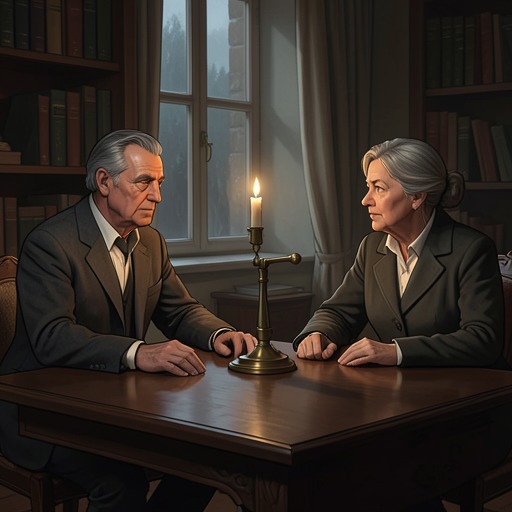
The episode appears under the date heading “The Barbarian Invasions (2030).” Marco is in the last moments of his life, with Rodrigo present and the people invited by Miraijin gathered around him. Though ill and undergoing treatment, Marco has planned how the gathering should proceed and what he wants to tell those who have come.
He has considered and rejected gestures he regards as overly theatrical: music, a farewell speech, solemnity, and displays of self-pity. Instead, he intends to offer a simple embrace to anyone who wants one and a clear explanation that those present are neither accomplices nor responsible for his choice. His insistence on plainness establishes the scene’s terms: this is not a family decision being made on his behalf, but a decision Marco means to own.
Marco’s Explanation
Marco speaks to the group as a doctor, drawing on his forty years in the profession to explain that he is acting in complete autonomy and with full mental clarity. He says Rodrigo’s role will be limited to giving him a brief period of peace, and stresses that he could carry out the act himself. The distinction matters to him: assistance is present, but the decision and responsibility remain his.
He identifies the contents and intended effects of the two infusion bags connected to the line in his right arm. One contains midazolam and propofol, which he describes as commonly used for general anesthesia and prepared to produce deep sedation; the other contains an infusion of potassium. He declines to explain how he obtained the substances, but assures the group that no one was told what he intended to do with them. His professional account is both practical explanation and protection of those around him from the implication that they arranged or authorized his death.
Marco also sets out what will happen afterward. Miraijin is to call 118; an ambulance will come from Castagneto Carducci, and the death will be reported. She will explain his condition and show his medical records. Marco predicts that no one will seek further information or require those present to give false testimony. He therefore tells them they need not remain until the ambulance arrives, while reassuring them that staying will not make them responsible or expose them to questioning.
The Gathering and Its Response
Before Marco begins, nobody knows what to say, and the assembled group remains still. He thanks them for coming and says he is glad to have them near. He notes that the gathering was Miraijin’s idea, acknowledging her role not in choosing his death but in bringing the people he wants beside him together.
His explanation proceeds as he intended. Nobody leaves except Marina, and Giacomo’s two restrained sobs are the only visible break in the formal composure of the scene. When Marco has finished, Miraijin leaves Oscar’s embrace, joins her grandfather, bends down, and hugs him. She praises him; the exchange gives the farewell a moment of closeness without turning it into the speech or ceremony Marco had rejected.
Final Moments
Marco thanks Rodrigo, who touches his shoulder. Marco then opens the red tap himself and rests his hand on his thigh. In the account of the final minutes, he looks at the five people before him and then at Miraijin, asking her to bend close. He reaches toward her hair, and she changes the position of her hand so that their right hands meet in a gesture whose meaning Marco recognizes as the “strong point.” As the anesthetic takes effect, his awareness recedes into a floating, underwater peace.
The gesture makes assistance intimate without making it equivalent to taking over Marco’s decision. He has opened the tap; Miraijin’s action is to meet him in the closing moment, while Rodrigo has supplied the practical help Marco described. The scene’s final physical contact is between grandfather and granddaughter, turning the organized gathering into a personal goodbye.
Memory and Narrative Significance
As Marco prepares to die, Irene suddenly comes to mind. He imagines that she would be proud of him and remembers that she killed herself when she was only a little older than Miraijin. This return connects his final act to the earlier death without equating the circumstances: the narrative presents Irene’s suicide as a painful family memory, while Marco’s present decision is explicitly framed through his explanation of autonomy and mental clarity.
The scene has already made Irene’s crisis legible through warning signs that the family fails to recognize. In an earlier episode, she listens repeatedly to Lydia Lunch’s version of “Gloomy Sunday,” the song known as the “Hungarian song of suicides,” while her exhaustion is visible in her altered appearance and manner. The narration stresses that the song functions as an alarm that no one hears, and that Letizia does not notice how depleted Irene has become. Elsewhere, Probus reflects on whether, for an instant, he had the impulse to shoot Aldino during an angry confrontation; he concludes that the improbable coincidence that killed Aldino makes it feel as if he had killed him himself. These earlier passages establish a family shaped by unspoken danger, missed signals, and retrospective responsibility. Against that history, Marco’s careful explanation is an effort to make his own intentions unmistakable and to prevent his loved ones from being left to invent a different account.
The title “The Barbarian Invasions” places the farewell within a larger sequence of remembered cultural references, while the scene itself moves between clinical detail and family intimacy. Marco speaks in the language of professional competence, yet his last attention turns to Miraijin and to the people he carries within himself: Irene, Adele, his father, and his mother. After Marco falls asleep, Miraijin supports and protects him; Rodrigo remains to turn on the blue tap. The ending thus holds together the boundaries Marco has tried to draw—his decision is his own, and the others are not to be made accomplices—with the care that remains around him as his life ends.